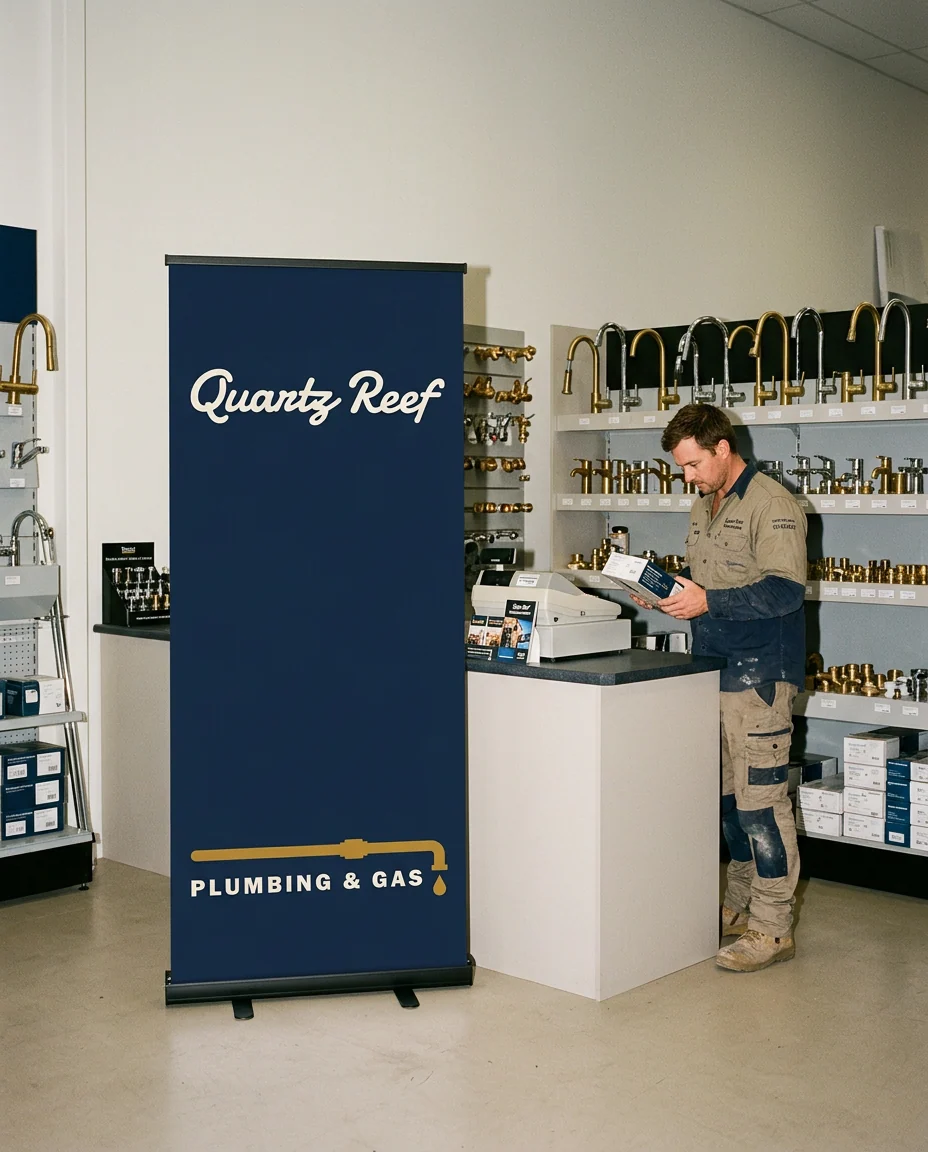
The pull up banner vs X banner question comes up every time someone books a stall at an expo, an open day or a market. They look similar from across a room: a tall printed graphic on a light stand that packs into a bag. Up close, they are built differently, and that changes how long they last and how they look in front of customers.
The short version: pull-up banners are the polished, long-term option, and X-banners are the affordable, swappable one. Here is how each works and how to decide.
How does a pull-up banner work?
Pull-up banners (also called retractable banners) keep the printed graphic inside a metal cassette base. You pull the graphic up, attach it to a support pole, and the banner stands on its own on any flat surface. Packing up is the reverse: the graphic rolls back into the base and the whole unit goes into a padded carry bag.
What's good about it: a professional presentation, clean lines and a stable base. The graphic stays protected inside the cassette when it is not in use, and the mechanism makes setting up quick and easy. The standard size is 850mm x 2000mm.
The trade-offs: it costs more than an X-banner. The graphic belongs to the cassette, so you can replace it, but not as simply as swapping a poster. The mechanism also has a lifespan: hundreds of uses, but not infinite.
Best for: trade shows, expos, open days, reception areas, and standing displays in shops or offices. If you'll use the banner regularly over months or years, a pull-up is the right investment. We also carry premium pull up banners if you want to compare the two on price and options.
Before you order: keep your key message in the top two-thirds of a pull-up banner. The bottom section often sits behind tables, chairs and people's legs.
How does an X-banner work?
X-banners use a collapsible X-shaped frame that holds the printed graphic at four corners. The graphic stretches across the frame and the whole thing stands on a simple foot support.
What's good about it: it is more affordable than a pull-up banner. The graphic is easy to swap: print a new one and attach it to the same frame. It is light and compact when packed, which makes it a good entry-level portable display.
The trade-offs: it is less stable than a pull-up because there is no weighted base. The graphic can bow or wrinkle if the tension isn't right, and the frame is lighter and less durable. It looks functional rather than premium.
Best for: one-off events, displays on a tight budget, situations where you change the graphic often, and indoor use where wind isn't a factor.
Pull up banner vs X banner: which should you buy?
If you'll use it regularly and presentation matters, go pull-up. If you need something affordable for occasional use, go X-banner. If you're not sure, a pull-up banner is the safer investment: it lasts longer, looks better, and it is always ready to go when a last-minute event comes up.
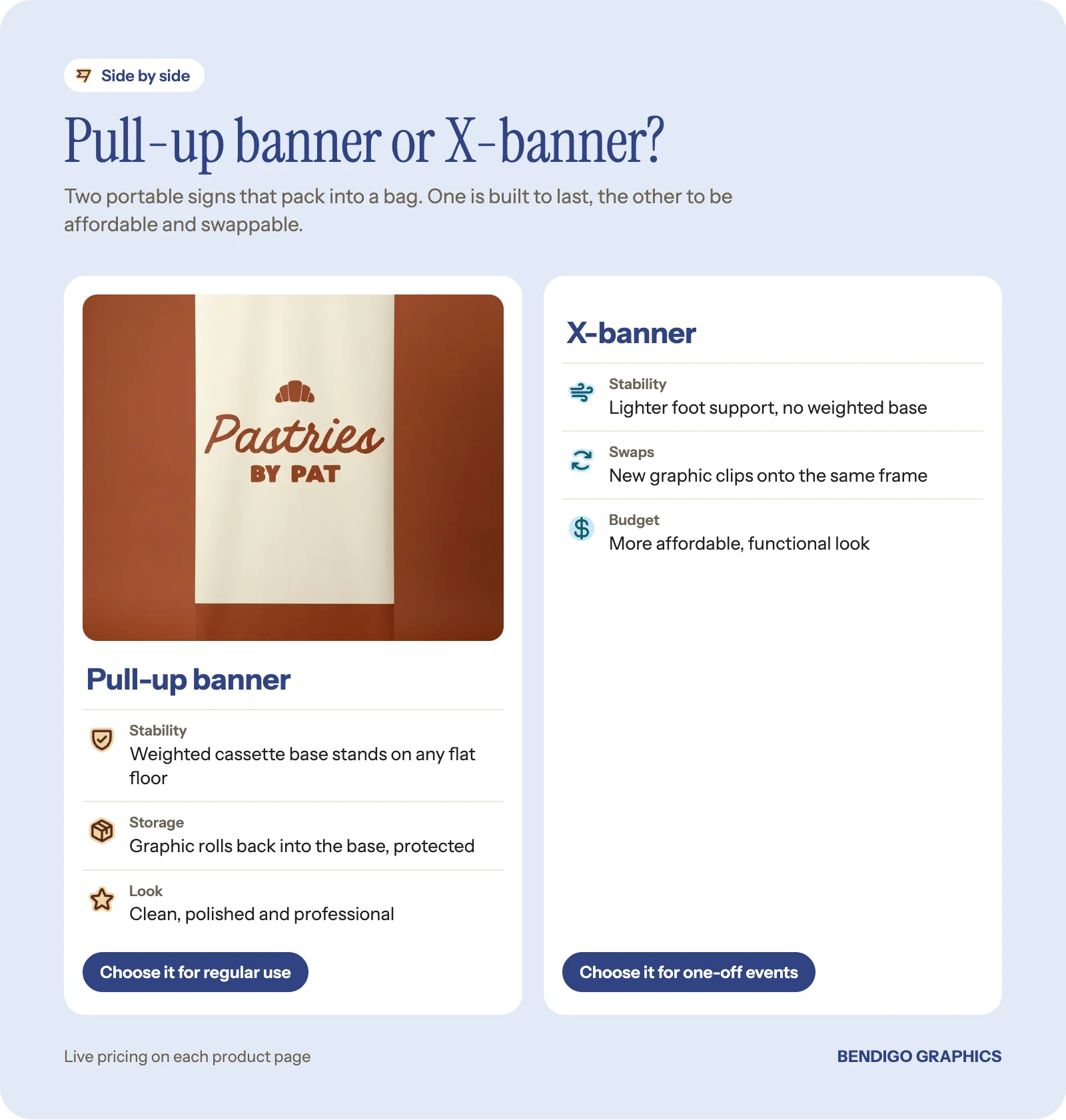
It also helps to think about who carries it. A pull-up is one bag with the graphic protected inside. An X-banner is lighter, but the graphic is handled every time it goes on and off the frame, so it pays to roll it rather than fold it.
Rule of thumb: if it will come out more than a few times a year, or it stands in front of customers you want to impress, the pull-up pays for itself.
Can either one go outside?
Both are built for indoor use first. A pull-up's weighted base copes better with a draughty doorway or a covered walkway, but neither is made to stand in open wind. For a footpath, a market in the open or a field day paddock, look at an outdoor option instead, such as custom flags or vinyl banners tied to a fence or frame. Our trade show and field day display checklist covers the full kit for outdoor events.
What should go on a portable banner?
People read a banner while walking past, so give them three things: who you are, what you do, and one way to find you. A logo near the top, a short line in large type and a web address or phone number is plenty. Leave the long list of services for a flyer on the table.
Top third: logo and what you do, readable from a few metres away.
Middle: one strong image or a short list of three points at most.
Lower third: contact details or a QR code, kept above table height.
For more on sizes and reading distance, see what size sign or banner you actually need.
Common questions
What size is a standard pull-up banner?
The standard pull-up banner is 850mm wide and 2000mm tall. You can see the sizes we offer, with live pricing, on the product page.
Can I replace the graphic later?
Yes, on both. An X-banner is the easier swap, since the new graphic simply attaches to the same frame. A pull-up graphic can be replaced too, but it is fitted to the cassette, so it is more involved.
Which is more stable?
The pull-up banner. Its weighted cassette base keeps it steady, while an X-banner stands on a lighter foot support with no weighted base.
Can you design the banner for me?
Yes. Upload your artwork, start from a template, or have us design it. Our local team checks every proof before anything is made.
Get yours ready for the next event
Choose a size on the pull-up banners product page to see live pricing and an estimated turnaround, then pick it up from Lyttleton Terrace or have it delivered. For the rest of the range, browse our signs and banners.