Event signage has a different job from business signage. A shop sign is read by people who have time to look. An event sign is read in passing, in a crowd, by someone trying to find the toilets, the car park or the right stage.
That changes what goes on it. Here is what earns its place, what can go on if there is room, and what to leave off.
What must go on event signage?
The event name and date. People need to confirm they are at the right place on the right day. It sounds obvious until you see a banner that says "Annual Fundraiser" with no date, year or anything else to identify it.
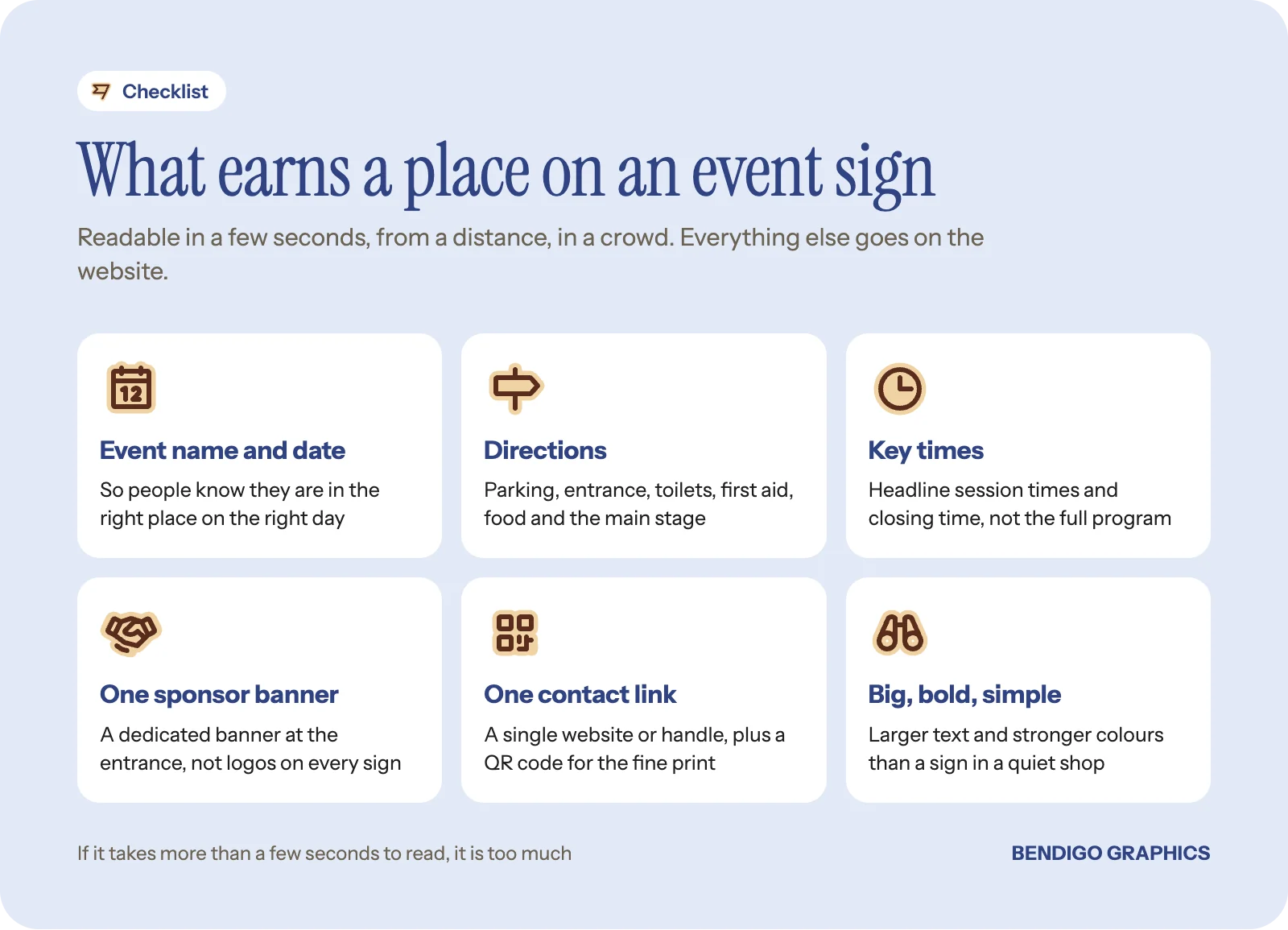
Direction arrows. Parking, entrance, toilets, first aid, food, the main stage. Visitors are finding their way around an unfamiliar space with a crowd around them. Clear directional signs prevent bottlenecks and a lot of repeated questions for your volunteers.
Key times. If the event runs to a schedule, with performances, sessions or a closing time, put the headline times where people will see them without checking their phone.
Quick tip: if you run the same event every year, leave the date off the big banner and put it on a separate corflute sign or small panel. The main banner then works year after year.
What to include if there is room
Sponsors. If you have them, they expect to be seen. A dedicated sponsor banner at the entrance does more for them than cramming logos onto every sign.
One contact or social link. One handle or website for people who want to follow up after the event. Keep it to one, not a list of every platform you are on.
What to leave off
Long descriptions. Nobody reads a paragraph on a sign at an event. If it takes more than a few seconds to take in, it is too much.
Fine print. Terms, conditions and disclaimers belong on your website. Add a web address or QR code to the sign if you need to point to them.
A wall of sponsor logos. Lots of small logos on one sign gives no sponsor real visibility. Keep sponsor signage separate from wayfinding.
Design event signs for distance
Event signs are seen from further away, in busier surroundings, than business signs. Go bigger with the text, bolder with the colours and simpler with the message. A sign that works perfectly in a quiet office disappears in a crowded showground.
One message per sign. A direction sign points one way to one place.
Strong contrast, dark on light or light on dark, so it reads in bright sun.
The same colours and fonts on every sign, so people learn to look for them.
Arrows big enough to read at walking pace.
Our guide on what size sign or banner you need helps you work out sizes from viewing distance.
Which signs suit which job at an event?
Marking the entrance: custom flags at the gate tell people they have found you before they read a word. They come with a pole set and base and are easy to put up yourself.
The event name on a fence: a vinyl banner with hemmed edges and eyelets, or a mesh banner on temporary fencing so the wind passes through.
Directions and times: corflute signs are light, easy to move and simple to store for next year.
Sponsor recognition: one banner or board at the entrance, where everyone walks past.
For more ideas that work around town, see banners Bendigo locals actually notice.
How to plan your event signage
Walk the site with a map.
Mark every decision point: gates, forks in paths, car park entries, the spot where people wonder where the toilets are.
Note what each point needs to say, in as few words as possible.
Group the signs you can reuse every year and the ones that need this year's details.
That list is your order.
Before you order: leave time for design and proof rounds, and order well ahead of the event date. Each product page shows an estimated turnaround, and how early to order printing for events has a simple planning guide.
Common questions
What should an event banner say?
The event name, the date and, if it matters, the main time or a web address. Anything more and people will not read it from a distance.
How many signs does an event need?
One for each decision point on the site, plus the entrance and a sponsor banner if you have sponsors. Walking the site with a map gives you the real number.
Can we reuse event signs next year?
Yes, if you keep the year and date off the main pieces. Put changing details on a separate small panel and store the banners rolled or flat.
Who puts the signs up?
Your team does. Flags and corflute signs are easy to set up yourself, and banners tie onto fences through their eyelets.
See the full range of signs and banners, each priced live on its product page. Planning an event? Send us the details and a rough site map, and we will help you work out which signs you actually need.


