You have a good idea for merch: shirts for the crew, totes for an event, mugs for your regulars. Then you hit the usual wall, where every printer seems to want an order of a hundred or more. What if you only need ten? Or three?
Small batch printing is very doable. You just need to know which products and print methods suit a short run, and how to size your first order so you are not left with boxes of leftovers.
Why do printers push big minimums?
Most big online printers are built around volume. Their setup is designed to run hundreds of the same thing at once, which only makes sense for large batches. Setting up takes time, cleaning down takes time, and one job of two hundred is easier to run than ten jobs of twenty.
That is why you see high minimums alongside low per-unit prices. It works for a large business or a big event. It does not work for a local cafe, club, side hustle or small team that wants a merch order that neither eats the whole budget nor fills the storage cupboard. The answer is choosing methods where the setup is light and the minimums can come down.
Which print methods suit small batch printing?
As a rule, anything printed digitally is fine in small numbers, and anything that needs tooling (screens, plates or an embroidery file) costs more per piece until the quantity goes up.
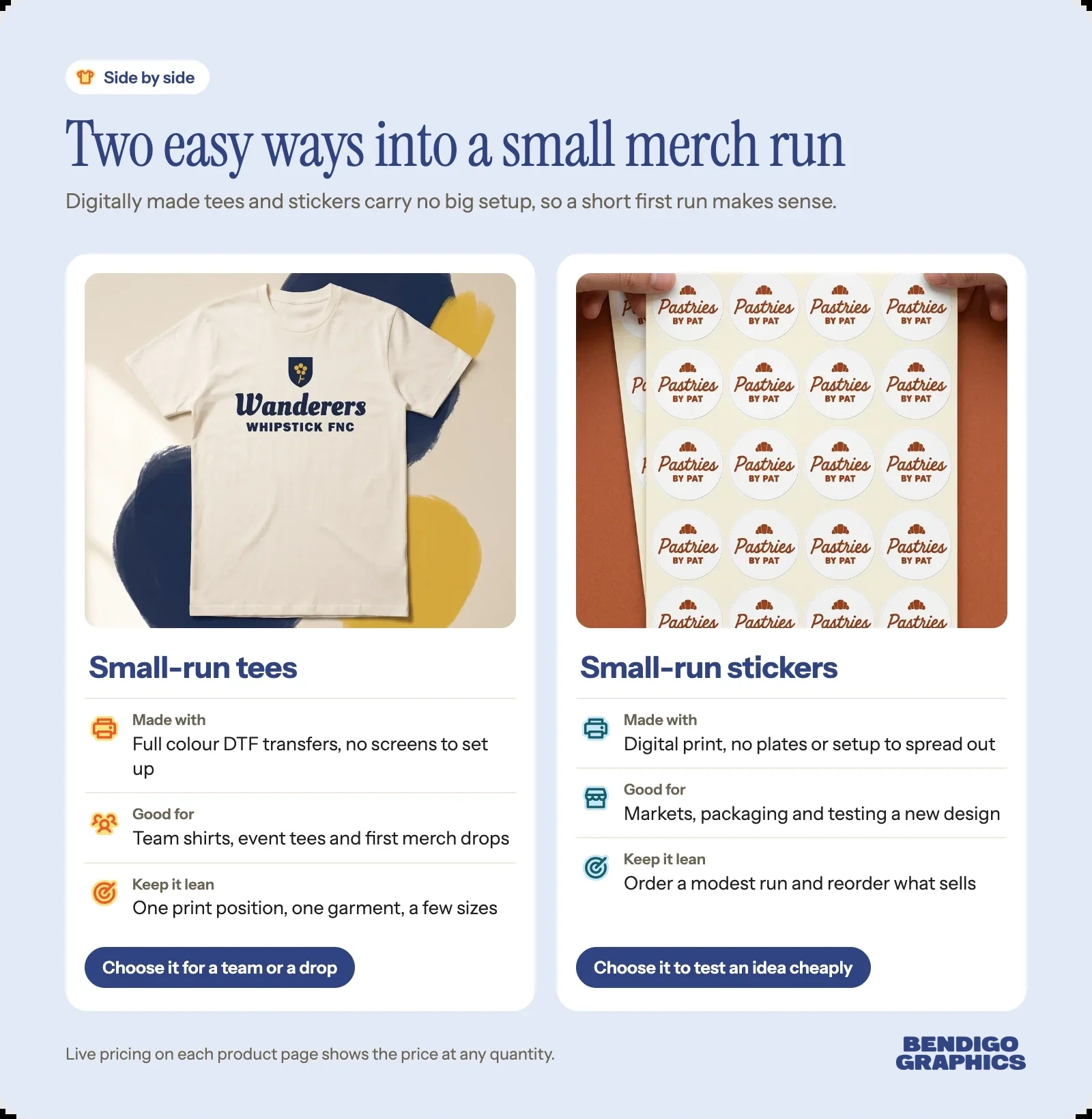
Digital and DTF: stickers, business cards, flyers, signs and full colour apparel. No plates or screens, so a small run carries no big setup.
Screens, plates and stitching: screen printing, offset booklets and embroidery. Each has a setup step that is paid once, so the cost per piece is high on a small order and falls as volume rises.
Rule of thumb: for a handful of shirts, or a design with lots of colours, go digital or DTF. Screen printing starts to make sense when the run is large and the design uses only a few flat colours.
Which print method suits your run?
Three quick questions, one recommendation.
See every answer
Digital or DTF. No screens or plates, so a small run carries no big setup. Each print is produced digitally and heat-pressed on, and full colour is fine.
Screen printing. Worth it when the run is large and the design uses only a few flat colours. The setup is paid once, so the cost per piece falls as volume rises.
Embroidery. Best for a small, simple logo on polos and caps. The stitch file is a one-off setup, so on a very small order a printed option is usually better value to start.
Low minimum merch: the products that work
Apparel
For apparel, full colour prints are made with DTF (direct-to-film) transfers. Each print is produced digitally and heat-pressed onto the garment, so there is no screen to spread across the order, which is why DTF suits small runs. Our guide to DTF printing explains the difference from screen print. Screen print still wins on very large runs of a simple design, but for merch drops, event shirts and small team orders, DTF is the practical choice.
Stickers
Stickers are one of the few products where small runs are the whole point. Digital printing means no plate and no screen, so you can order a modest run of die-cut stickers or sticker sheets and still get sensible value from each one. They are ideal for testing a design, running a limited drop or keeping a small stock for markets.
Business cards
The standard business card order used to be a thousand. For most small businesses that is too many: you will change a number, a website or a logo long before you get through them. A couple of hundred on good stock is plenty for most people.
Promotional items and signs
Some promotional products suit short runs far better than others. Logo mugs, stubby holders and tote bags can often be done in low quantities. You may pay a bit more per item, but you are not stuck with two hundred you cannot shift. Signs are small batch by nature: you need one shopfront sign, one banner, one corflute sign, and the price moves with size and material rather than quantity.
How many should you actually order?
It is easy to over-order out of optimism or under-order out of caution. Think in stages instead. For a new design, treat the first run as a test and order just enough to:
cover your team or your regulars
have a few extras to sell or give away
see how people respond in the real world
If it sells or gets good feedback, reorder with confidence. If it does not, you have not tied up cash in boxes that never moved. The same applies to staff shirts, aprons and club gear: start small, confirm the sizes, fit and comfort, then roll it out. For team orders, our guide to how many shirts to order helps with the numbers.
Before you order: get a couple of people to try the garment in a few sizes first. Sizing varies between brands, and it is much easier to fix on a small first batch than on the whole team’s order.
Order in stages, not all at once
Treat the first run as a test.
- Cover the coreOrder enough for your team or your regulars.
- Add a few extrasA handful to sell or give away.
- Try the sizes firstGet a couple of people to try the garment before the whole order goes in.
- Watch the responseSee how people react in the real world.
- Reorder with confidenceIf it sells, the next run can be bigger, which brings the cost per piece down.
How to keep a small run affordable
Short runs will nearly always cost a bit more per piece than big ones. The goal is to keep the total spend sensible.
Simplify the design. One strong graphic in one position costs less than a front, back and sleeve print.
Choose sensible products. A first run does not need the fanciest garment. A solid, comfortable blank like the Classic tee does the job.
Think in tiers. Start small. If it works, the second order can be bigger, and bigger runs bring the cost per piece down.
Order until something changes. For cards and printed stationery, order enough to last until the details are likely to change.
When a small batch is the smart move
Ordering fewer items is not just about saving money. Small runs are the right call when you are testing a new logo or design, running a one-off event with no need for leftovers, working with limited storage, or making limited edition merch that should feel special. Staying flexible lets you learn what customers like and grow the range over time instead of guessing on day one.
Start with a tee: the Classic tee is priced live on the product page. Choose your colour, sizes and quantity, then upload your design or have us design it.