If you have asked for a small run of printed shirts lately, you have probably heard the letters DTF. So what is DTF printing, and why does it matter to a cafe, a club or a small business that only needs a dozen tees rather than a few hundred?
In short, it made small runs of full-colour apparel practical. This guide explains how it works, what it does well, where screen printing is still the better choice, and how to get a good result from your artwork.
How does DTF printing work?
The design is printed onto a special PET film using CMYK and white inks. A hot-melt adhesive powder is applied to the wet print and then cured. The finished transfer is heat-pressed onto the garment at high temperature and pressure, and the adhesive bonds the print to the fabric fibres.
The result is a full-colour, photo-quality print on almost any fabric colour, including dark garments, thanks to the white ink underbase. There are no screens, no screen setup and no limit on the number of colours.
Why DTF changed small-run apparel
Screen printing needs a physical screen for each colour in the design. Setting up those screens costs money whether you're printing five shirts or five hundred. Spread across a small order, that setup made custom apparel expensive at low quantities.
DTF has no screen setup. Each print is produced digitally, so the cost per shirt stays much flatter as quantities drop. A small business can order a handful of custom tees without ordering hundreds, without paying a premium that only makes sense at scale.
What does DTF do well?
Full colour with no colour penalty. A 12-colour design costs the same to print as a 1-colour design. Photos, gradients and detailed artwork all print without extra setup.
Small runs. Each item is its own print, so one-offs, mixed designs and a few names or sizes are all practical.
Any fabric colour. The white underbase gives vivid prints on black, navy, red or any dark garment.
No screens to make. Jobs go straight from a finished file to production. Each product page shows an estimated turnaround; allow extra time for design and proof rounds, and order early for events.
When is screen printing still better?
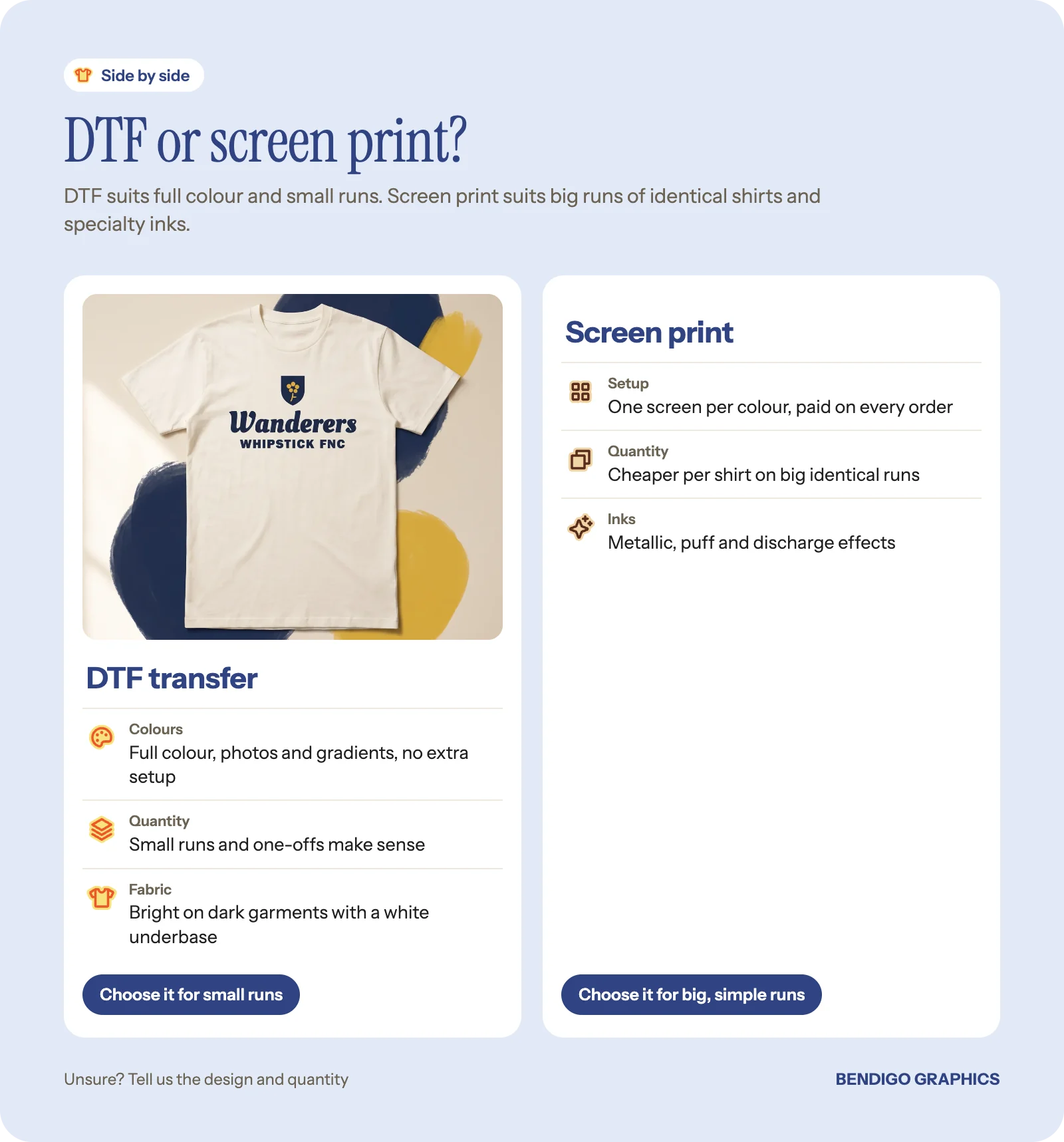
Big runs of identical shirts. Once the screens are set up, screen printing is faster and cheaper per unit at volume. The setup cost that hurts small orders becomes minor at scale.
Extreme durability needs. Screen print ink bonds into the fabric more aggressively than DTF adhesive. For industrial workwear washed constantly in commercial machines, screen print lasts longer.
Specialty inks. Metallic, puff and discharge (bleach-out on dark garments) are screen print techniques that DTF can't copy.
Rule of thumb: lots of colours or a small quantity points to DTF. One or two colours on a big run of identical shirts points to screen print. If you're unsure, tell us the design and the quantity and we'll recommend a method.
Does the garment matter?
A lot. DTF prints best on quality cotton or cotton-blend garments, and we use AS Colour blanks as standard, such as the classic tee, the relax hood and the stock cap. Cheap polyester or heavily treated retail fabrics can cause adhesion problems, and the print may crack or peel early.
The garment is half the product. Don't undermine a good print with a thin blank that loses its shape after a few washes. Our guide to what makes printed merch feel good, not cheap goes into fabric weight and fit.
What drives the cost of a DTF printed tee?
With DTF, the price of a printed tee comes down to a few things:
the garment you choose
how many print positions (front, back, sleeve)
the size of each print
the quantity
The cost per unit drops as quantities rise, but there are no screen fees and the number of colours doesn't change the price. Every combination is priced live on each product page, so you can try a front-only print against front and back before you decide.
Before you order: send your design as a high-resolution PNG with a transparent background, or as a vector file. Anything you don't want printed, like a white box around the logo, needs to be removed, or it will show on the shirt.
How to design for DTF
You can place your artwork on a garment's real print areas online with our apparel designer, choosing left chest, full front, full back and more, and see it on the garment before you order. Our team then checks it before anything is made.
A few habits help: keep fine lines and small text a sensible size so they hold up on fabric, check your colours against the garment colour you have picked, and think about where people will actually see the print. A left chest logo with a bigger back print is a popular pairing for staff shirts.
Common questions
What is DTF printing?
DTF stands for direct-to-film. Your design is printed onto a film with a white underbase, coated in an adhesive powder, then heat-pressed onto the garment. It gives full colour with no screen setup.
Is DTF good for dark shirts?
Yes. The white ink underbase keeps colours bright on black, navy and other dark garments.
How do I look after a DTF print?
Turn the garment inside out, wash it cool and avoid ironing directly over the print. Gentle care helps the print last as long as the shirt.
What is the smallest order I can place?
Because each print is made digitally, small runs are practical. Choose your quantity on the product page and the price updates as you go.
Try it on your next run
Pick a colour, sizes and print positions on the classic tee product page to see live pricing, then upload your design or have us create one. For hoodies, caps, polos and more, browse our apparel range.