Customers walking into a new space make fast decisions about where to go, what to do and who to talk to. Wayfinding signage for shops, cafes and clinics is what makes those decisions easy. Done well, nobody notices it. Done badly, everybody notices the queue in the wrong place.
Here is how to plan signage that moves people through your space and saves your staff from answering the same questions all day.
People do not read, they scan
Nobody studies your layout. People scan for cues: a sign that says order here, an arrow to the bathroom, a label above the counter that explains the menu. If those cues are missing, people hesitate. They stand in the wrong spot, queue at the wrong counter and ask your staff the same question over and over. That is not a customer problem. It is a signage problem.
What is wayfinding signage for shops?
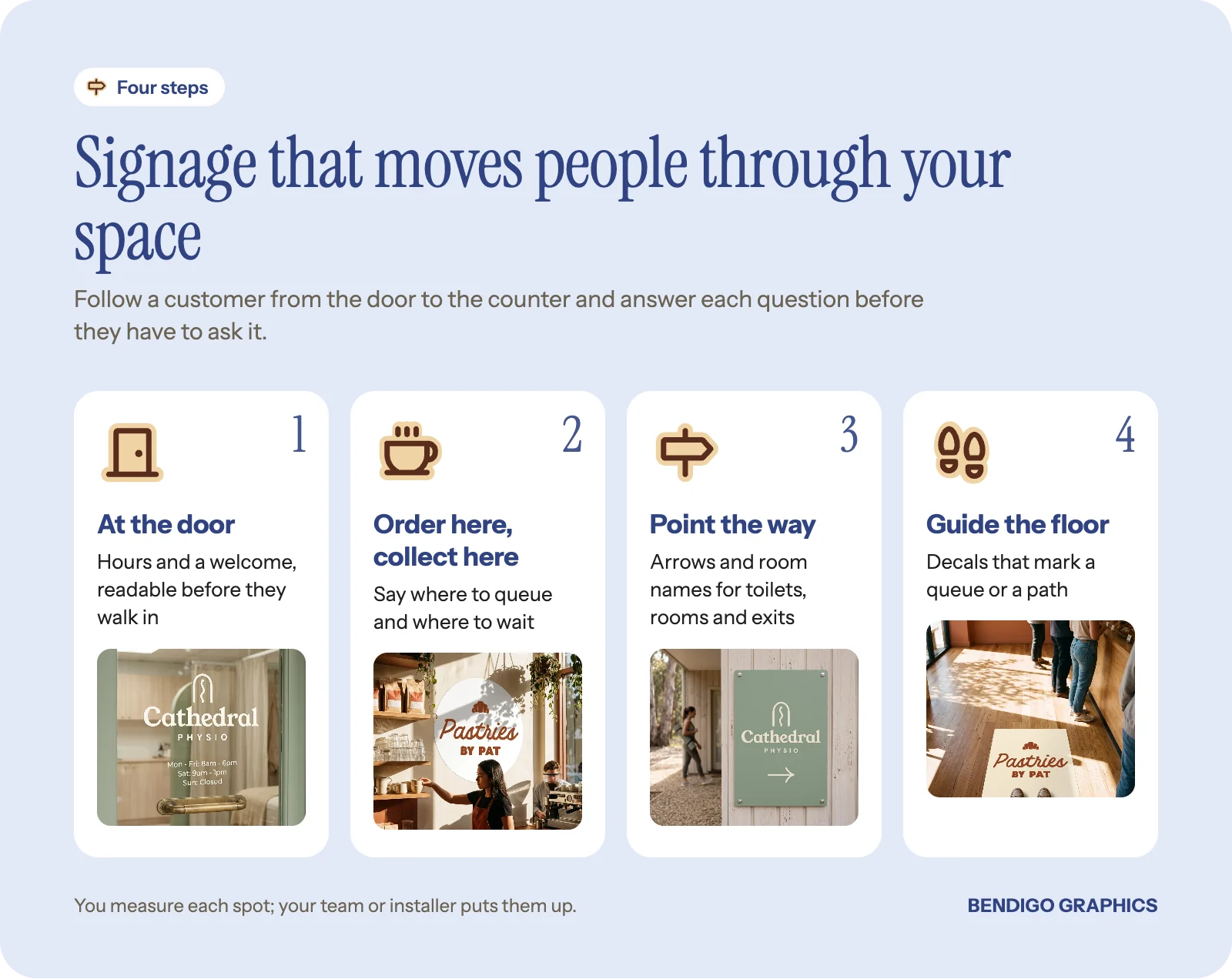
Wayfinding is the formal term for signs that tell people where to go. In a cafe, it is the order here and collect here signs. In a clinic, it is the reception sign and the waiting area sign. In a retail store, it is section labels and fitting room signs.
None of it needs to be elaborate. A clean vinyl lettering decal on the wall behind the counter. A small panel on a stand. Window lettering on the glass door. The design should match your brand, but clarity comes first. If someone cannot read it from three metres away, it is not doing its job.
Quick tip: test a sign before you order it. Print the wording on a sheet of paper at roughly the planned size, tape it up and read it from where your customers actually stand.
Menu boards and price lists speed up the queue
When people can see what you offer and what it costs before they reach the counter, they order faster and with more confidence. When they cannot, they hold up the line asking questions, or they fall back on the safest option because they feel rushed.
A properly printed menu board or price list does more than look better than a handwritten one. It speeds up service, cuts down on errors and lets your staff focus on making things rather than explaining things.
Directional signs for bigger spaces
If your business has several rooms, floors or zones, directional signage is not optional. Arrows, room labels, floor numbers, exit signs and bathroom signs all prevent the where-do-I-go conversation that takes up staff time and makes customers feel awkward.
It matters most for businesses that host events, classes or appointments. Someone arriving for a workshop should be able to find the right room without asking reception. Wayfinding signs for doors and corridors and floor decals for queues and paths do most of that work. Where safety or compliance signs are needed, safety signage can be designed to sit alongside the rest of the set.
The signs your staff will thank you for
Ask your team which question they hear most often. Then make a sign for it.
"Wi-Fi password is on the table."
"Bathrooms are down the hall, second door on the left."
"Please wait here to be seated."
"BYO welcome."
These are not exciting design projects. They are practical tools that save your team from repeating the same sentence all day, and that is worth more than most people realise.
How to plan a set of signs that match
Signs ordered one at a time tend to drift: different fonts, different colours, different sizes. Plan them as one set, alongside the rest of your signs and banners, and they read as part of the business rather than a pile of notices.
Walk the customer path from the footpath to the counter and out again.
Note every point where someone hesitates or asks a question.
Write the shortest wording that answers it.
Measure the wall, door, window or stand where each sign will go.
Before you order: for each sign, list the wording, where it goes and the size of the spot. Send us that list and we can design the whole set in one go so it all matches. Your team, builder or an installer you choose then puts them up.
If you are fitting out a new space, our signage checklist for opening a cafe or shop covers the outside of the building too.
Common questions
How big should a wayfinding sign be?
Big enough to read from where people will first see it. As a starting point, test the wording on paper at the planned size and read it from that spot. Our guide to choosing a sign size goes into more detail.
Do small businesses really need directional signs?
If customers ever ask where the toilets are, where to order or where to wait, yes. A handful of small signs usually covers it.
Can signage match our brand and still be clear?
Yes. Use your colours and typeface, keep the wording short and make sure there is strong contrast between the text and the background. Clarity first, style second.
Point the way: wayfinding signs are priced live on the product page. Choose your sizes and quantity, and have us design a set that matches your brand.


