Every few years someone declares the letterbox dead, and every week letterboxes around Bendigo still fill up with menus, real estate cards and trade offers. Letterbox drop flyers have not disappeared because, for the right business, they still bring people through the door.
The honest answer is that they work best when they are targeted, useful and repeated, and poorly when they are none of those things. Here is how to tell which side of that line your drop will fall on.
Do letterbox drop flyers still work?
They can, for businesses whose customers live nearby. A letterbox drop is one of the few ways to reach every household in a chosen area, including people who are not on social media and do not search for you until they need you. It is also physical: a flyer gets picked up, looked at for a second or two, and sometimes stuck on the fridge.
Where they struggle is when the offer is vague, the area is wrong or the drop happens once and never again. A single drop tells you little. A planned run of drops tells you a lot.
Which businesses get the best results?
Trades and home services working in a defined area: plumbers, electricians, gardeners, heating and cooling.
Takeaway, cafes and restaurants with a menu and delivery zone.
New businesses telling a neighbourhood they have opened.
Gyms, studios and clinics with an introductory offer.
Real estate agents building a presence in the streets they list in.
What these have in common is that the customer is local, and the offer is something people need now or soon.
Flyer or postcard?
Flyers and pamphlets are the classic choice. They are printed full colour on both sides on 150gsm gloss stock, in sizes from A6 to A3, flat or folded. DL is the letterbox-friendly size, and a folded flyer gives a takeaway or a trade room for a full service menu.
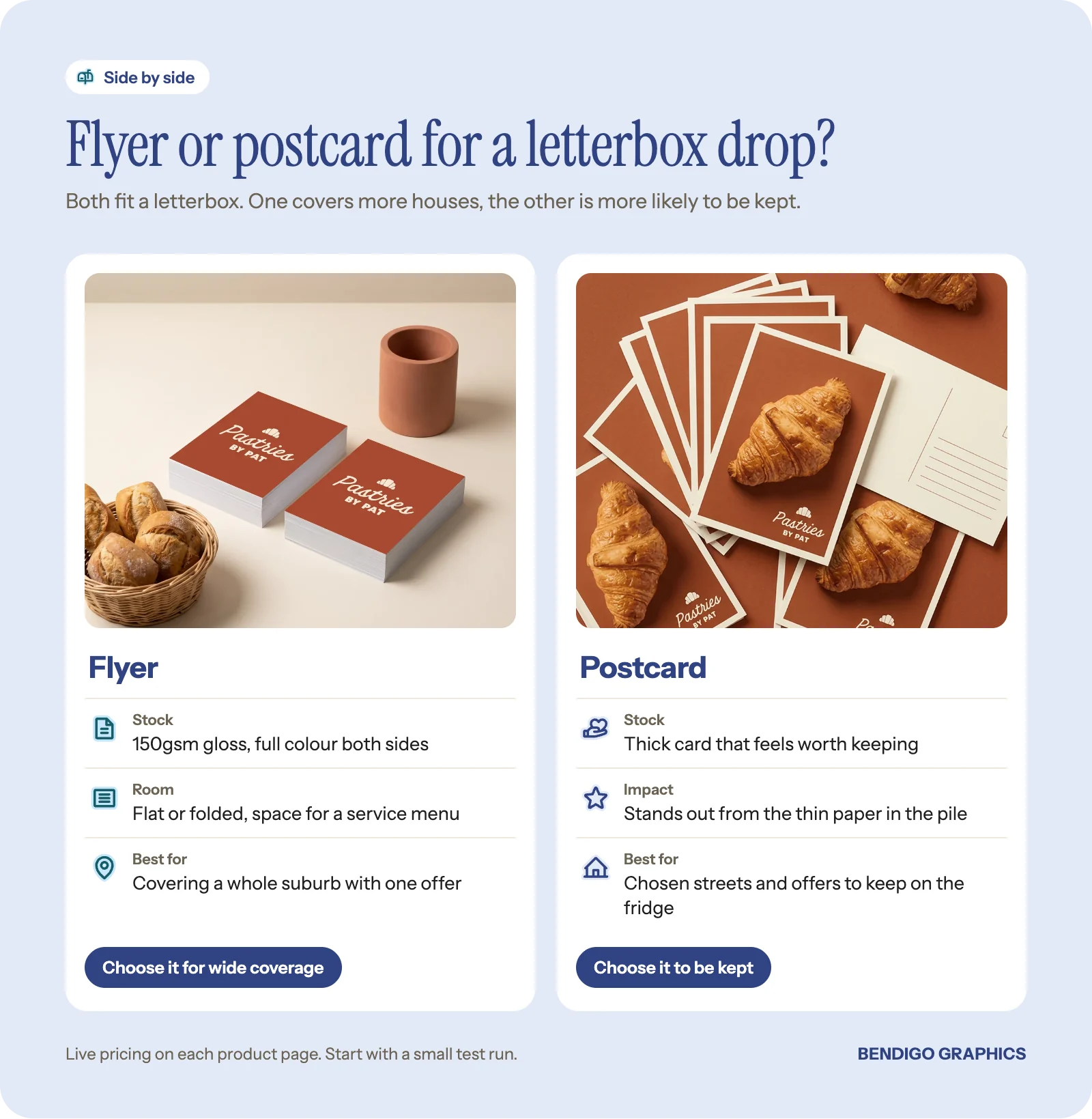
Postcards are printed on thick 300 to 400gsm card. They feel different in the hand from the thin paper around them, and they are more likely to end up on the kitchen bench than in the recycling. If you are dropping to fewer, carefully chosen streets, a postcard often earns its extra weight.
If you need more space, such as for a practice or a firm explaining its services, a folded brochure does the job, though it suits a counter or a mailout better than a cold drop.
Quick tip: start small. Flyers and postcards can be ordered in small quantities, so test one area before printing for the whole town.
What makes a flyer worth keeping?
One clear offer. A first visit discount, a free quote, a spring service. One, not five.
A local headline. Naming the suburb or the season shows it was made for them.
An easy next step. A phone number in big type and a QR code that goes to a booking or offer page.
A reason to act soon. An end date gives people a nudge.
Something useful. A menu, opening hours or a price list people will keep, even if they do not need you today.
Our guide to printing for seasonal specials has more on making a single offer work, and preparing files for printing helps if you are designing it yourself.
Choosing your streets
The biggest lever is where the flyers go. Start with the streets closest to your shop or the suburbs you already work in. New estates are worth a look too: households that have just moved in need everything from a plumber to a local cafe, and growing areas around Bendigo such as Huntly, Maiden Gully and Strathfieldsaye add new letterboxes every year.
Always respect "No junk mail" signs. Putting a flyer in a letterbox that asks you not to is the quickest way to make a bad first impression.
Delivering it yourself or using a distributor
Walking the streets yourself costs time but tells you a lot about the area, and you can target exactly the houses you want. A letterbox distribution service suits bigger runs across several suburbs. Either way, one flyer per letterbox, pushed in properly so it does not blow down the street.
How can you tell if it worked?
Build a way to measure into the flyer itself:
A code or offer that only appears on this flyer.
A QR code that goes to its own page, so visits can be counted.
Asking every new customer how they heard about you, and writing it down.
Run the same drop more than once before you judge it. People often need to see a name a few times before they call. If you want to track it alongside your online marketing, our guide to local SEO for regional businesses shows how the two support each other.
Rule of thumb: judge a letterbox campaign on the enquiries it brings in over a few drops, not on the first week after one.
Common questions
Are letterbox drops still worth it for a small business?
For a local business with a clear offer and a defined area, often yes. For businesses whose customers are spread across the state, other marketing usually works better.
What size flyer is best for a letterbox drop?
DL is the classic letterbox size. A6 postcards are compact and feel sturdier, and A5 gives more room for a menu or a list of services.
How many flyers should I print?
Start with enough for one test area, see what comes back, then scale up to the streets that responded.
Can you design the flyer for us?
Yes. Send your offer and your logo, and our team will lay it out and send a proof before anything is made.
Ready to try a drop? Order flyers with live pricing, or see the full print advertising range.