Sooner or later, every owner who has been doing their own marketing at night asks whether to hand it to someone else. The choices are doing it yourself, hiring someone, using freelancers, or paying an agency or a monthly plan, and each one costs something different: money, time or control.
If you are weighing up whether to outsource marketing as a small business, this guide lays out what each option really involves, the questions to ask any provider, and how our own plans compare.
The short answer
If you need one or two skills now and then, a freelancer is usually the simplest choice. If marketing is a daily job with enough work to fill a full-time role, and you have time to manage it, hiring someone makes sense. If you need several skills working together every month, such as design, social, ads, SEO and print, without managing a team yourself, an agency or a monthly marketing plan is often the better fit.
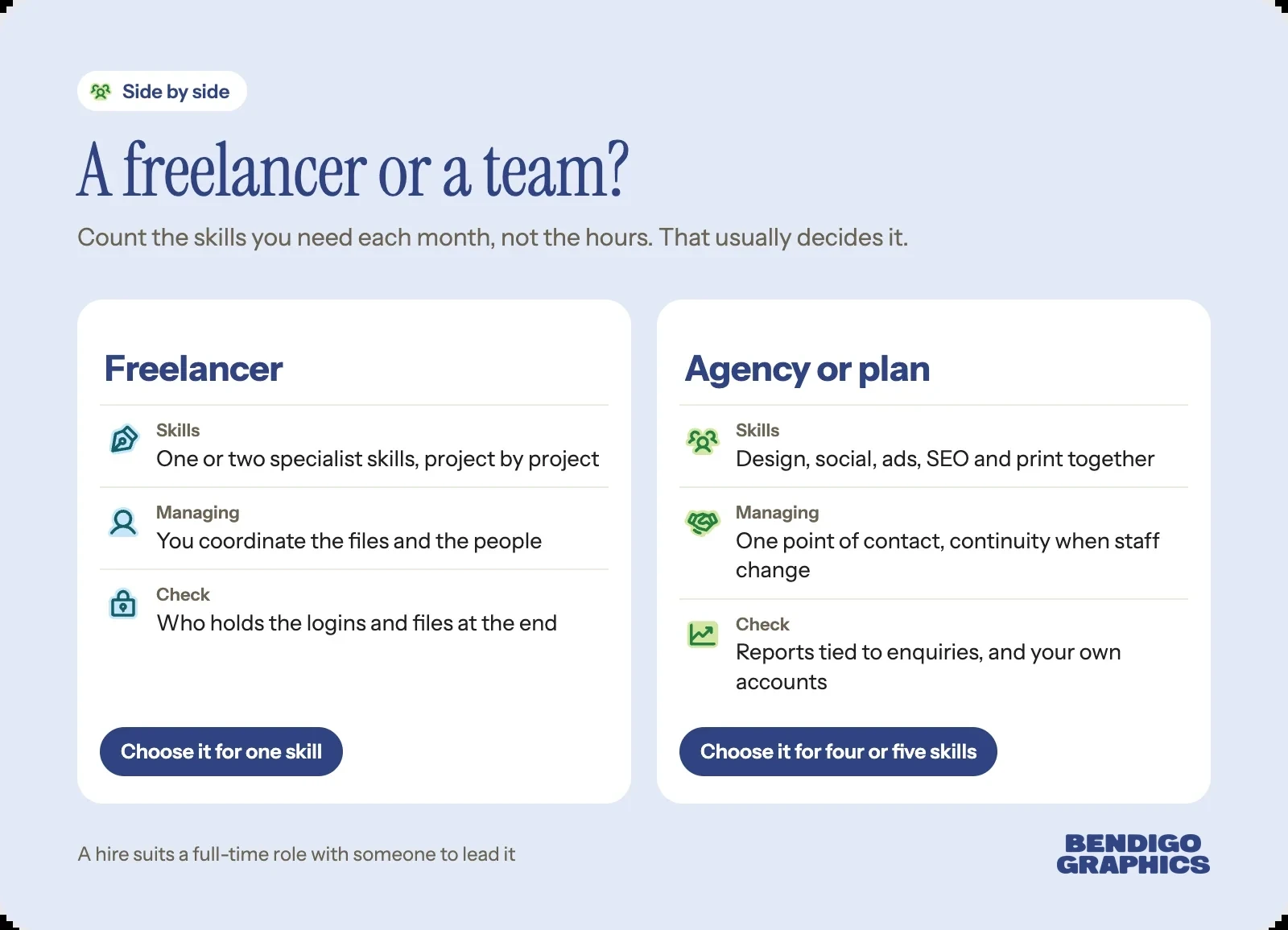
Most businesses move through more than one of these as they grow. The right choice is the one that suits where you are now.
Which way should you go?
Three questions about where your business is now.
See every answer
Keep doing it yourself. Nobody knows the business better. Hand over the pieces that slip first when you get busy.
Use a freelancer. Specialist skills without a long-term commitment. Check who holds the logins and files when each project ends.
Hire in-house. Makes sense when there is a full-time role's worth of work and someone in the business has time to lead it.
An agency or monthly plan. Several skills working together, one point of contact and continuity when people change.
Doing it yourself
Most small businesses start here, and there’s nothing wrong with that.
The upside: nobody knows your business better, and it costs time rather than money.
The downside: time is the one thing you’re short of. Marketing is usually the first job dropped when you get busy, which is exactly when you need the next wave of work lined up.
Where it breaks: skills gaps. Running Google Ads, writing a website page, designing a sign and photographing your work are four different trades.
Hiring an in-house marketer
A dedicated marketer knows your business, is there every day and can react quickly.
The costs go beyond the salary: super, leave, software, training and a computer, plus the ad budget they’ll spend. The harder limit is skills. One person rarely covers design, copywriting, ads, SEO, photography and reporting equally well, so a new hire often still needs freelancers or an agency behind them. They also need managing, and when they move on, much of what they know leaves with them.
A hire makes the most sense when there’s a full-time role’s worth of work and someone in the business has the time to lead it.
Using freelancers
Freelancers give you specialist skills without a long-term commitment. A good freelance designer or ads specialist can do excellent work on a project basis.
The catch is coordination. With a designer, a web developer, an ads person and a photographer, you become the project manager, passing files between them and making sure everything still looks like the same business. Check who holds the logins, files and accounts when each project ends.
Should a small business outsource marketing to an agency?
An agency or a monthly plan gives you several skills working together, one point of contact and continuity when people change.
The things to watch are cost, long lock-in contracts, reports full of numbers that don’t connect to sales, and not owning your own accounts. A good arrangement solves those up front.
Decision rule: count the skills you need each month, not the hours. One skill, hire a freelancer. Four or five, with no time to manage them, and you need a team, either on your payroll or on a plan.
Freelancer, in-house or a plan
What each one costs you in money, time or control.
| Compared | Freelancer | In-house | Agency or plan |
|---|---|---|---|
| Skills covered | One specialty | One person's range | Several together |
| Who manages it | You | You or a manager | The agency |
| Commitment | Per project | Salary and on-costs | Monthly |
| When someone leaves | Find another | Knowledge walks out | Work carries on |
| Watch for | Coordinating everyone | Skills gaps | Lock-ins, vague reports |
Questions to ask any marketing provider
Whichever way you go, ask these before you commit:
Who owns the ad accounts, website, domain, social pages and design files?
Is ad spend paid directly to Google and Meta, or marked up and passed through?
What will you report each month, and does it show enquiries and sales, not just likes and clicks?
Who approves posts, emails and ads before they go out?
What’s included, and what’s charged separately?
What’s the minimum term?
Can I see work you’ve done for businesses like mine?
Our guide to what a monthly marketing report should tell you goes deeper on the reporting question, and social media management: what to outsource looks at splitting the social work.
How our Marketing Plans work
We offer three monthly plans, with every price published on our marketing plans page, so you can compare them with the options above.
Local. Your Google profile rebuilt and kept current, Google posts every week, every review answered and a review request sent after each job.
Growth. Everything in Local, plus social posts made and posted for you, Google or Meta ads, and design jobs included every month.
Department. Your whole marketing department: a post every day, Google and Meta ads, more design jobs, email campaigns, a photo and video day each quarter and a monthly strategy call.
On every plan, ad spend is paid directly to Google and Meta so the accounts stay yours, print production is charged separately, and you approve posts, emails and ads in the customer portal before anything goes out.
Worth knowing: a plan like Department covers work that would otherwise need a designer, a social media manager, an ads specialist and someone to pull the reporting together. Compare it with the combined cost and management time of those roles, not with any single one.
Compare the plans
See what’s included in each plan side by side on our Marketing Plans page.