Your work vehicle is parked outside clients’ houses, in hardware store car parks and on job sites all day. Putting your name on it is one of the most useful things a trade business can do. The first decision between magnetic signs and vinyl decals is whether you want signage that comes off at the end of the day or signage that stays on for years.
That is really the whole question when it comes to magnetic signs vs decals. Here is how each works, what each suits, and how to look after them.
Magnetic signs vs decals: the short answer
If the vehicle is also the family car, or you are not sure you want permanent branding, choose magnetic signs. If the vehicle is a dedicated work ute, van or trailer, choose vinyl decals. Decals look more finished, handle curves and stay put. Magnets give you branding on the job and a plain vehicle on the weekend.

How magnetic signs work
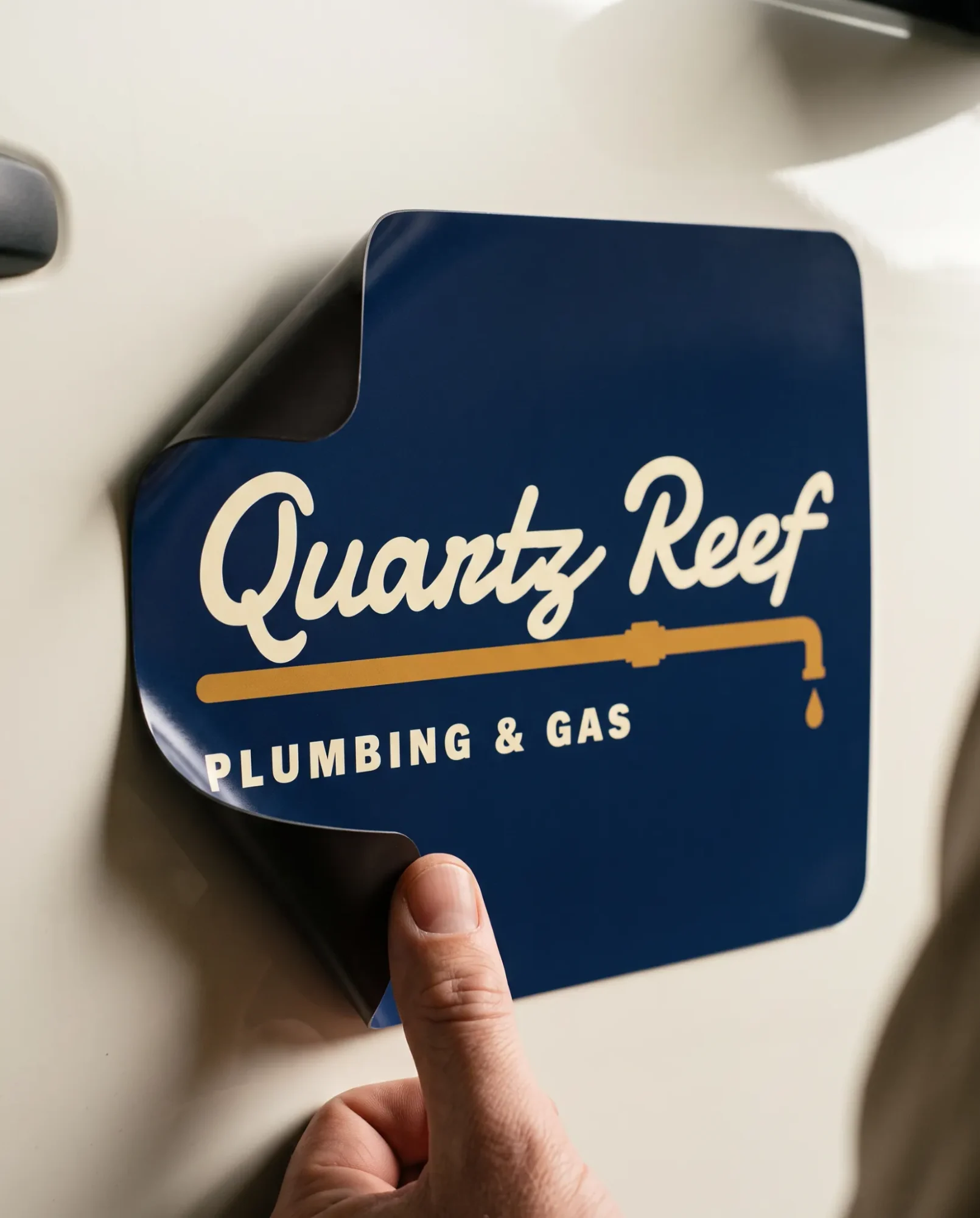
Our magnetic car signs are printed on vinyl and applied to 0.85mm flexible magnetic sheet, then cut to a clean rectangle. They sit on a flat steel panel, most often the front doors, and come off by hand whenever you want. Single colour signs use cut vinyl on a white magnetic base; multi colour signs are fully printed, so photos, gradients and detailed logos all work.
What they are good at:
Branding a private car during work hours only.
Shared or leased vehicles, where permanent decals are not allowed.
Testing a design before committing to decals.
Moving your branding between vehicles.
Their limits: magnets are always a rectangle, they need a flat or gently curved steel surface, and they are easier for someone else to take off than a decal.
How vinyl decals work
Car lettering decals are either cut from solid colour vinyl, letter by letter, or printed in full colour and cut around the shape of your logo. There is no background panel, so the lettering looks painted on. Cast vinyl conforms to curves and body lines, which matters on modern utes and vans with shaped doors.
For bigger vehicles, trailer and truck decals carry larger lettering, and our wider vehicle signage range covers partial designs across doors, tailgates and rear windows. If you are weighing up cut lettering against printed stickers, see when cut vinyl lettering beats stickers.
Decals are supplied with application tape, ready to apply. You can apply them yourself on a clean, dry, mild day, or have your chosen installer do it.
Will a magnetic sign stick to my vehicle?
Not every panel is steel. Some vehicles use aluminium or composite panels, and bumpers and some tailgates are plastic. The easy test is a fridge magnet: if it grabs firmly across the whole door, a magnetic sign will too. If it slides or does not stick at all, decals are the answer for that panel.
Check the shape as well. A magnet needs full contact, so deep body lines, rubbing strips and door handles all reduce the flat area you can use.
Before you order: measure the flattest area of each door, clear of handles and trims, and send us the sizes with a photo of the vehicle. We design to your measurements.
Looking after magnetic signs
Magnets are low fuss, but a few habits keep them and your paint in good shape:
Take them off regularly and wipe both the magnet and the panel, so dirt and moisture do not get trapped underneath.
Take them off before a car wash.
Store them flat, not rolled or folded, and not on a hot dashboard.
Put them on a clean, dry panel, and press them down from the centre out so the edges sit flat.
Which suits your business?
Sole trader using the family car: magnetic signs on the front doors.
Dedicated work ute or van: vinyl decals, with your name, trade and number on both sides and the back.
A small fleet: decals for consistency, so every vehicle looks the same.
A trailer that goes to every job: decals, sized to be read from the car behind. See our guide to trade vehicle branding for layout ideas.
Plenty of businesses use both: decals on the work van and a pair of magnets for the second car when it is pressed into service.
Magnetic signs or vinyl decals?
Three quick questions about your vehicle.
See every answer
Magnetic signs. Branding on the job and a plain car on the weekend. Fit them to the flattest steel area of each front door.
Vinyl decals. They follow curves, stay on and look painted on. Put your name, trade and number on both sides and the back.
Decals and a pair of magnets. Decals on the work vehicle for a finished look, and magnets for the second car when it is pressed into service.
What should go on either one?
Keep it readable at a distance: your business name, what you do in a few words, a phone number and a web address. Skip long lists of services. Our guide to what needs to go on trade signage explains the order that works.
Rule of thumb: if someone stopped behind you at the lights cannot read your phone number, it is too small.
Ready to put your name on the road? See our vehicle graphics range, where each product shows live pricing and an estimated turnaround.