A listing board is often the first thing a buyer sees of a property, and the first thing the neighbours see of your agency. Good real estate signs are simple to read from a moving car, consistent across every listing, and quick to turn around when a new property comes on.
This guide covers the sizes to order, which material suits which job, and what should and should not go on the board.
What sizes do real estate signs come in?
Our real estate boards come in two standard sizes: 600 x 900 mm and 900 x 1200 mm. The smaller size suits a front fence, a unit block or a narrow frontage. The larger one gives a photo and a headline room to breathe on a standard suburban block.
For bigger boards, such as a photo board for an auction or a commercial listing on a main road, corflute signs and aluminium composite signs can be made to the size you need. If you are unsure, our guide to choosing the right sign size works through viewing distance.
Rule of thumb: think about where the board is read from. A quiet court can take more detail. A busy road needs a bigger board with fewer words.
Corflute or aluminium composite?
Both materials take a full colour print, and our real estate boards can be ordered in either. The choice comes down to how long the board needs to last.
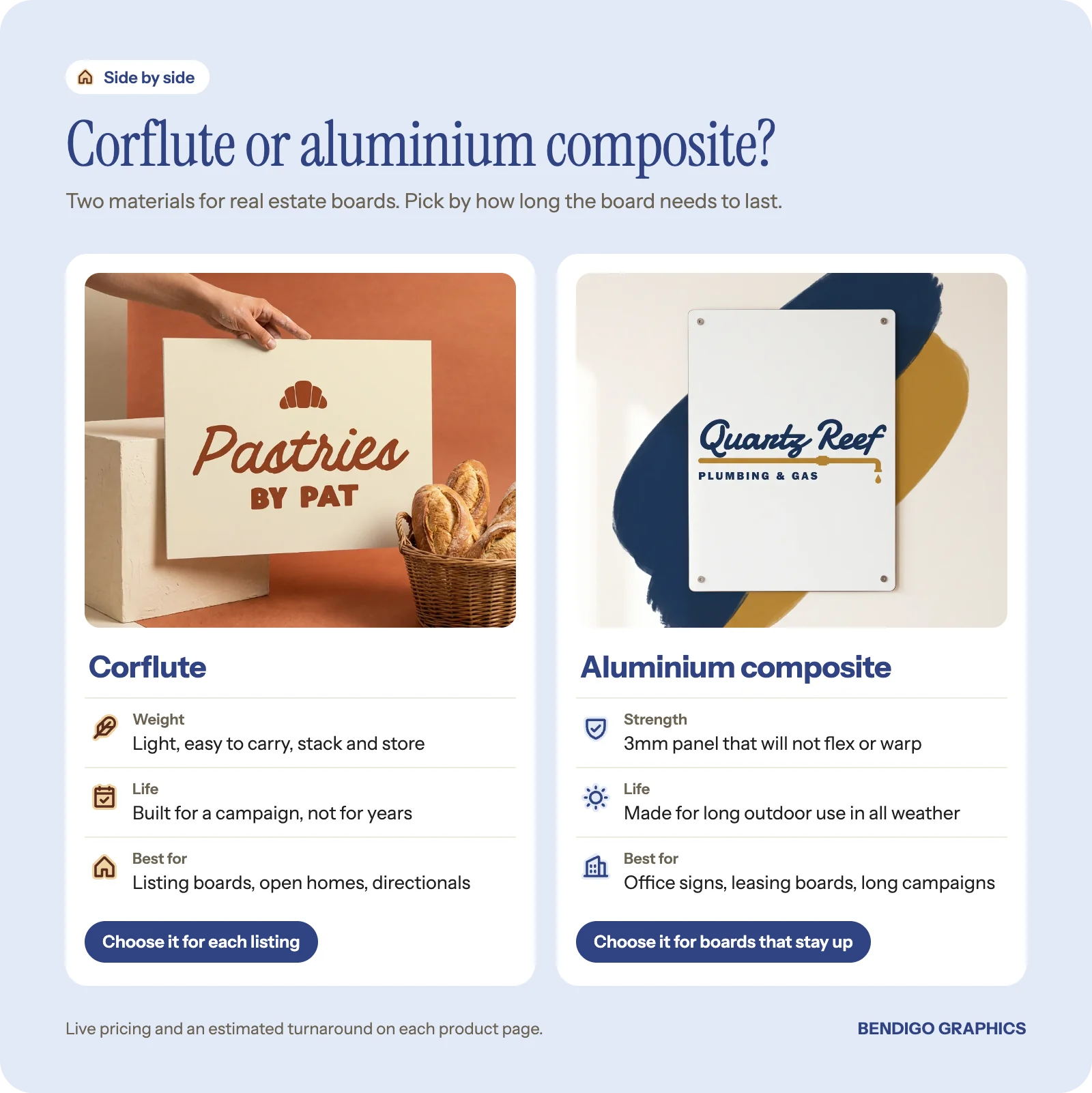
Corflute is fluted plastic board. It is light, easy to carry and affordable enough to use for a single campaign, which makes it the everyday choice for listing boards, open home signs and directional arrows. It is made for a campaign rather than for years outdoors. Our guide to corflute signs covers it in more detail.
Aluminium composite is a 3mm panel with an aluminium face. It is rigid, will not flex or warp, and suits signs that stay up for a long time: the sign on your office, a leasing board on a commercial building, or a development that will be marketed for months. If the board faces traffic both ways, double-sided ACM signs carry the artwork on both faces.
What to include on a real estate sign
A board is read in a few seconds. Give it a clear order:
The status. For sale, for lease or auction. This is the biggest thing on the board.
One strong photo, if it is a photo board. The front of the house or the best room, not a collage.
One feature line. "Walk to the lake" or "Four bedrooms, big backyard". One line only.
The agent's name and mobile. Large enough to read from the footpath.
Your agency logo, in the same place on every board.
A way to see more. A short web address or a QR code that goes straight to the listing.
What to leave off: the full property description, a list of every feature, and small print that nobody can read from the street. That belongs on the listing.
Signs for open homes and auction day
On the day, people need to find the property and know it is open. A custom flag at the kerb is easy to spot from the end of the street and packs down into its bag between inspections. Corflute directional arrows at the nearest corners guide buyers in, and a solid A-frame at the gate can carry the inspection times.
Keep open home signage generic where you can. "Open for inspection" with your logo works for every listing, so you are not reprinting for each property.
Sold, under contract and auction stickers
Rather than reprinting a board when a property sells, most agencies use a sticker across it. Die-cut stickers in your brand colours make "Sold", "Under contract" or an auction date look like part of the board rather than an afterthought. Order them in bulk so every agent has a stack.
Keeping every board consistent
When every agent in an office orders their own boards, the brand drifts. Agree a set layout for each board type, with the logo, colours and type in the same place every time, and keep the master files together. A short set of brand guidelines makes this easy for new staff. Once the layout is agreed, each new listing is only a change of photo, feature line and agent.
Ordering boards for each listing
A smooth routine for a new listing looks like this: send the agency layout, the listing photo and the agent's details; check the proof on screen; approve it; then collect the boards or have them delivered. Each product page shows an estimated turnaround, so you can see when the board will be ready before the listing goes live.
Before you order: confirm how your boards are mounted. We supply the printed panels, and your board installer or your team puts them up on your frames or posts.
Common questions
What size are real estate signs?
Our real estate boards come in 600 x 900 mm and 900 x 1200 mm. Larger boards for auctions or main roads can be made to size in corflute or aluminium composite.
Is corflute or aluminium better for real estate signs?
Corflute for boards that go up for one listing. Aluminium composite for signs that stay up for a long time, such as office and leasing signs.
Do you install real estate boards?
No. We design, proof and supply the boards, and your installer or your team puts them up.
Do we need permission to put up a sign?
Rules about signs on nature strips and public land vary between councils, so check with your local council if a board is going anywhere other than the property itself.
Ready for your next listing? Order real estate boards with live pricing, or browse the full range of signs and banners.